
Top 3 Tips for Telephone Interviews

Today, I’m excited to welcome guest author and syndicated columnist, Joyce Lain Kennedy who has provided her Top 3 Tips for Telephone Interviews: 

1. The telephone call is a screening call. The interviewer aims to be sure that your qualifications meet the requirements of the position. Draw verbal links between a company’s requirements and your qualifications: “You want X, I offer X; you want Y, I offer Y; you want Z, I offer Z.” Make the connection!

When the call comes in unsolicited and you don’t already know the requirements of a position, ask: “To be sure we’re clear on this position, can you tell me the job’s requirements?” Take notes and connect the dots.

2. Make phone appointments. Whenever possible, don’t answer questions on the fly when the call comes in. And especially don’t interview on your cell phone while you’re out and about. You won’t be prepared and you won’t do your best. Schedule an appointment for your phone interview. Say that you’re walking out the door to a meeting across town and will call back as quickly as you can:

“Thank you for calling. I appreciate your attention. I’m very interested in speaking with you about my qualifications. Unfortunately, this is not a good time for me — I’m headed out the door. Can I call you back in an hour?”

If a recruiter insists on calling you back rather than the other way around, do what you would do for any other interview: Be ready early as a reminder to interview as a professional. Change out of your jeans and into the type of clothing you’d wear in a  business meeting. Most importantly, treat the call as an overture to an in-room meeting. And remember, a smile makes your voice sound better.

3. Don’t blow off the screening call. Interviewers ask about your experience, skills, competencies, education, your inconvenient geography, and whether your financial requirement is too low or too high for the job’s predetermined compensation range. (Know in advance the market pay range for various jobs by checking with such sites as salary.com.)

Use back-up phrases. After answering a question, add such follow-on phrases as “Does that answer your question?” “ Have I sufficiently answered your question about my managerial experience?” “Is this the kind of information you’re seeking?”

 Take telephone interviews seriously:

The reason to take screens seriously is that if you flunk them, you won’t be passed on to the next step in the hiring process, the selection interviewing sequence.
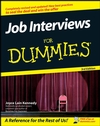
 Joyce Lain Kennedy (San Diego, CA) is a nationally syndicated careers columnist and the author of seven career books, including the recently released THIRD edition of Job Interviews For Dummies. For four decades, she has advised millions of readers on their career development and job search strategies.


Job Fairs: Matchmaking 101

Job fairs – a big speed-dating festival for job seekers and employers seeking their “one and only” who will be a perfect match…

Here are some tips to get the most out of your next job fair: 

1. Know what you want. As a job seeker, what kind of position do you wish to target? What kind of employer? Is that employer represented at this job fair? Find out by reviewing the ads for the fair – check out the sample companies represented at the job fair. Are they companies with whom you wish to work? 

2. List and research all the companies where you wish to work. I recommend creating “cheat sheets” for each company listing the following: company name, space for contact info (get a business card from each booth you visit so you can follow up), one or two things you learned about the company from your research, and three questions you want to ask them at the fair. This helps you stay on track, targeting the companies of your dreams, and also enables you to follow up with recruiters at the fair. Only one in 300 people ever follow up, so be the one who stands out. 

3. Dress professionally – just because recruiters are there doesn’t mean your attire can be sloppy, ill-fitting, and wrinkled. Recruiters get first impressions too. Make them good ones. 

4. Be prepared for a brief interview. As a former recruiter who’s attended lots of job fairs, we often had positions to fill immediately and were able to interview job seekers at the fair in a sectioned off interview area. Many of the other companies at the event did so as well.  

5. Have several CAR stories at the ready that demonstrate your ability to handle the job. CAR stands for “Challenge, Action, Result.” Since the majority of interviewers ask behavior-based interview questions, you want to be able to address them with specific examples of your expertise. 

6. Bring along several copies of your current resume. (No typos please.) Even if it is a job fair that provides an electronic copy of candidates’ resumes to each booth at the fair, the candidate should have plenty of resumes with him or her. Instant gratification is never a bad thing. And you’re prepared, in case you get a chance to interview on the spot. 

7. Smile. Just like dating, people are drawn to those who smile in a warm, friendly manner. And smiling keeps your attitude positive. As one HR manager told me, “I hire for attitude. You can always teach a skill.” 

Now, go get ’em. And let me know how your next job fair turns out. Good luck!  

The Great Thank You Note Debate

Oh, you didn’t know there was a debate, eh?

The Do’s:

“It’s the right thing to do,” said multiple sources including recruiters, employers, and career coaches. I agree, but here’s how to say THANKS the right way:

1. Always thank whomever for their time. Mention something personal, even if it is minor, that you learned about that person during the interview. If you are dropping the note to the secretary, mention how helpful or how pleasant they were during your wait.

2. Enclose a proposal or action plan regarding what you could do for the company. How you can SOLVE THEIR PROBLEM (whatever it was). You can mention accomplishments of yours that might be relevant to their situation. (Use your professional resume. There should be several listed from which you can choose!) This type of action plan makes you PROACTIVE. And shows how much you listened during the interview, how much you care about their company, and how much you’re dying to be a part of it.

3. If you interviewed several people, you may wish to enclose a second resume as a MEMORY JOGGER.

4. You want your letter to show your enthusiasm for the position/company, your compatibility with their team, how their goals match your goals, and your desire for the job! People have actually LOST positions because they didn’t ASK for the job. 

“It puts the candidate at the top of the call-if-(the)-No. 1-(candidate)-doesn’t-work list. In 5 years at Harvard, I saw this happen at least once a quarter,” said Susan P. Joyce, Editor/Webmaster, at Job-Hunt.org. She is “pro” thank you notes. 

“As a former hiring manager, I would be totally impressed with someone who wrote an appropriate thank you card,” said Jason Alba of JibberJobber.com. “It is above and beyond an e-mail, and shows a lot of thought. It is a gesture that would help me know that this person would take care of (internal and external) customers.” 

“In some situations, when considered with the interview, the thank you note had influence as to whether or not to extend an offer of employment,” said Steve Gallison, Professional Outplacement Assistance Center. 

As a former recruiter, I can tell you that Steve is right. I still remember getting a call from one employer saying, “Chris is fantastic! Do you know he FAXED over a hand-written thank you note right after his interview? WOW. When can he start?” Yes, Chris got the job. The employer had never received a thank you note from anyone in the past. The note made Chris stand out. Another client landed a job at Microsoft. The thank you note he sent got him over the top.

The Do NOT’s:

“Thank you notes are a waste of my time,” said one recruiter. “No one ever reads them.”

Not true. According to one executive recruiter, her candidate – who had aced the interview – lost the job offer. How? She sent a thank you note with spelling errors, typos, and bad grammar.

Of course thank you notes that just say, “Thanks for your time” are a waste of my time, said one HR director.

Instead, use this key paragraph provided by Don Orlando, MBA, of The McLean Group: “I want to do more than just thank you for your time. I was thinking about your problems and I have some ideas to help solve them. I know they must be tentative, but I’d like to get your reaction to them.” Check out No. 2 above for strategies to back up your claim.

Companies hire people who can solve their problems. Demonstrate how you can do so – and you’ve got a greater chance of getting in the door with a solid offer.

Am I a fan of thank-you notes? You bet.

Craigslist – a new way to get hired

Courtesy of Susan Joyce, Job-Hunt.org

I’ve run Job-Hunt.org since 1998, and I’ve been collecting job search success data off-line since since 2004. I keep a rolling total of what is working, although I haven’t published it on Job-Hunt. It helps me keep Job-Hunt focused on reality.

As you know from the other replies, most jobs are found off-line rather than online – more than 80% according to my data.

However, WHEN a job site is mentioned as the source of a job for “average” job seekers (professionals, entry level to mid-level, and lower level managers), the one mentioned is Craigslist! Literally, 20 to 1 over Monster. In the last 18 months,
CareerBuilder was not mentioned once, except as a source of spammy/sales messages. None of the niche sites was mentioned either. One of the people I interviewed landed a mid-level management job at a Verizon subsidiary (via Craigslist), but most of the jobs in the last 18 months have been below that level.

Craigslist is not perfect – it’s free for employers in all but 11 cities ($75 to post a job in SF, $25 in 10 other major metro areas, and free everywher else). That brings abuse from scammers and junk postings. Craigslist tries to limit the junk, but it’s definitely there. Communities can self-moderate, but some do a better job than others.

I have a guide to using Craigslist to find a job posted on Job-Hunt.