What to do when you can’t say NO

By Nicole Williams, www.nicolewilliams.com

Question: I have a million people asking me for favors and because I want to help I always say yes. Then I’m up all night trying to get everything done. How do I say no without making people wary of asking for my help in the future?

Answer: Repeat after me: NO. Explain that you’d love to help (if that’s true) but your schedule is jammed. Think quality instead of quantity. Select a few of the people/things you’d really like to dedicate some time to and go all out, rather than giving the half-assed effort that comes with sleepless nights and a lack of focus. I guess my question is: What would be so wrong with making people wary of asking you for anything and everything? Seems you could use a little decrease in the number of asks—a million is a lot.

What to do when an Interviewer Uncovers Your Digital Dirt

Did you know that 77 percent of recruiters Google candidates? It’s true, according to a 2006 ExecuNet survey. And 35 percent of recruiters eliminate candidates based on what they find on Google.  

As a job seeker, it’s imperative you know what people can see online about you. Do you have digital dirt? You know, that fun party you were at – and the pictures that were posted on your friend’s blog. Oops! 

Two things you can do about digital dirt – bury it or sweep it under the rug. If there are incriminating photos or crazy postings – ask the blogger to remove them. If however, your misdeeds were featured in a major newspaper, say The Wall Street Journal – then you’ll need to take more dramatic action. One quick step – start your own professional blog. Blogs get higher rankings in Google and there is a chance you can quickly bury your dirt.  

However, if your dirt is uncovered by an interviewer, be prepared to explain yourself calmly and BRIEFLY during an interview. 

Challenge: Take action! Google yourself right now – and check out the dirt. Use quotes around your first and last name – so the dirt is all on you. 🙂

Top 3 Tips for Telephone Interviews

Today, I’m excited to welcome guest author and syndicated columnist, Joyce Lain Kennedy who has provided her Top 3 Tips for Telephone Interviews: 

1. The telephone call is a screening call. The interviewer aims to be sure that your qualifications meet the requirements of the position. Draw verbal links between a company’s requirements and your qualifications: “You want X, I offer X; you want Y, I offer Y; you want Z, I offer Z.” Make the connection!

When the call comes in unsolicited and you don’t already know the requirements of a position, ask: “To be sure we’re clear on this position, can you tell me the job’s requirements?” Take notes and connect the dots.

2. Make phone appointments. Whenever possible, don’t answer questions on the fly when the call comes in. And especially don’t interview on your cell phone while you’re out and about. You won’t be prepared and you won’t do your best. Schedule an appointment for your phone interview. Say that you’re walking out the door to a meeting across town and will call back as quickly as you can:

“Thank you for calling. I appreciate your attention. I’m very interested in speaking with you about my qualifications. Unfortunately, this is not a good time for me — I’m headed out the door. Can I call you back in an hour?”

If a recruiter insists on calling you back rather than the other way around, do what you would do for any other interview: Be ready early as a reminder to interview as a professional. Change out of your jeans and into the type of clothing you’d wear in a  business meeting. Most importantly, treat the call as an overture to an in-room meeting. And remember, a smile makes your voice sound better.

3. Don’t blow off the screening call. Interviewers ask about your experience, skills, competencies, education, your inconvenient geography, and whether your financial requirement is too low or too high for the job’s predetermined compensation range. (Know in advance the market pay range for various jobs by checking with such sites as salary.com.)

Use back-up phrases. After answering a question, add such follow-on phrases as “Does that answer your question?” “ Have I sufficiently answered your question about my managerial experience?” “Is this the kind of information you’re seeking?”

 Take telephone interviews seriously:

The reason to take screens seriously is that if you flunk them, you won’t be passed on to the next step in the hiring process, the selection interviewing sequence.
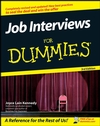
 Joyce Lain Kennedy (San Diego, CA) is a nationally syndicated careers columnist and the author of seven career books, including the recently released THIRD edition of Job Interviews For Dummies. For four decades, she has advised millions of readers on their career development and job search strategies.


Job Fairs: Matchmaking 101

Job fairs – a big speed-dating festival for job seekers and employers seeking their “one and only” who will be a perfect match…

Here are some tips to get the most out of your next job fair: 

1. Know what you want. As a job seeker, what kind of position do you wish to target? What kind of employer? Is that employer represented at this job fair? Find out by reviewing the ads for the fair – check out the sample companies represented at the job fair. Are they companies with whom you wish to work? 

2. List and research all the companies where you wish to work. I recommend creating “cheat sheets” for each company listing the following: company name, space for contact info (get a business card from each booth you visit so you can follow up), one or two things you learned about the company from your research, and three questions you want to ask them at the fair. This helps you stay on track, targeting the companies of your dreams, and also enables you to follow up with recruiters at the fair. Only one in 300 people ever follow up, so be the one who stands out. 

3. Dress professionally – just because recruiters are there doesn’t mean your attire can be sloppy, ill-fitting, and wrinkled. Recruiters get first impressions too. Make them good ones. 

4. Be prepared for a brief interview. As a former recruiter who’s attended lots of job fairs, we often had positions to fill immediately and were able to interview job seekers at the fair in a sectioned off interview area. Many of the other companies at the event did so as well.  

5. Have several CAR stories at the ready that demonstrate your ability to handle the job. CAR stands for “Challenge, Action, Result.” Since the majority of interviewers ask behavior-based interview questions, you want to be able to address them with specific examples of your expertise. 

6. Bring along several copies of your current resume. (No typos please.) Even if it is a job fair that provides an electronic copy of candidates’ resumes to each booth at the fair, the candidate should have plenty of resumes with him or her. Instant gratification is never a bad thing. And you’re prepared, in case you get a chance to interview on the spot. 

7. Smile. Just like dating, people are drawn to those who smile in a warm, friendly manner. And smiling keeps your attitude positive. As one HR manager told me, “I hire for attitude. You can always teach a skill.” 

Now, go get ’em. And let me know how your next job fair turns out. Good luck!